
Will Nationwide make £100 “Fairer Share” payments again in 2026?
Update 21 May 2026 – the Fairer Share payment for 2026 has been announced – see this article!
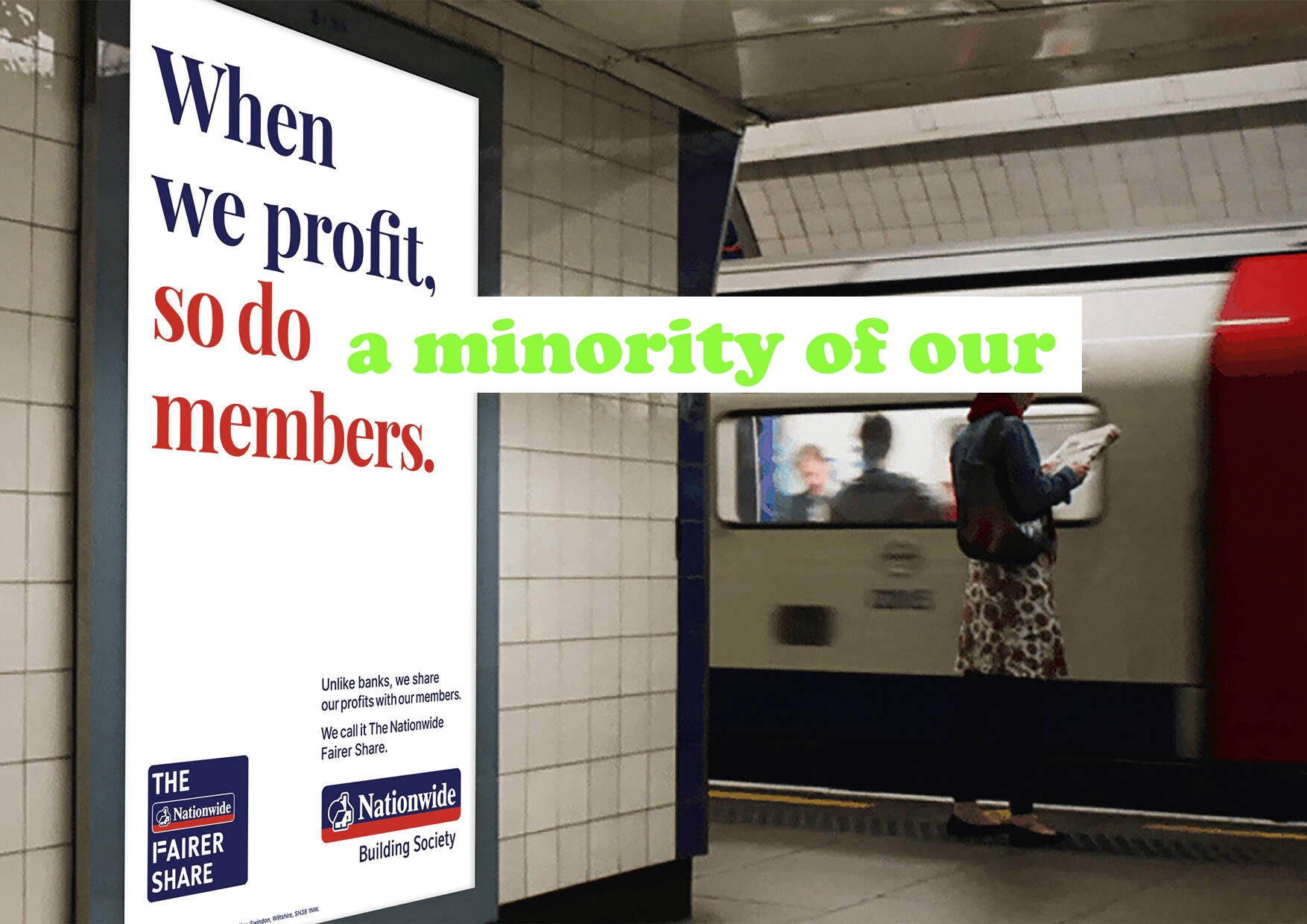
If Nationwide can again afford to make Fairer Share payments, this will be rightly celebrated by the recipients. However the majority of members that don’t receive these may be left questioning fairness: why do only a minority benefit, and is there a better use or more equitable distribution of members’ capital? Increasing transparency and member engagement are two key reasons why I’m asking members to elect me to the Nationwide Board this year.
James Sherwin-Smith, Member Nominated Candidate for election to the Nationwide Board
Nationwide Members can also vote this summer
James Sherwin-Smith is standing as a Member Nominated Candidate for Election to Nationwide’s Board
Learn why he believes Members deserve a stronger voice.
Nationwide’s “Fairer Share” payments have become a focal point for members: part loyalty bonus, part demonstration of the mutual model in action. Since its introduction in 2023, £100 payments have been paid annually to a growing cohort: 3.45 million members in 2023, 3.85 million in 2024, and over 4 million in 2025.
Set against a total membership of 16.4 million — and a reported 9.1 million members who are eligible to vote — this remains a minority benefit, albeit one that is expanding year on year. When it was introduced in 2023, the number of complaints raised prompted a statement from the Financial Ombudsman Service.
At its core, the Fairer Share is framed as a distribution of surplus to a subset of members rather than external shareholders. That positioning matters: it reinforces Nationwide’s mutual credentials and differentiates it from listed banks. However, the mechanics are less straightforward than a conventional dividend.
Crucially, the payment is not guaranteed, and not all members benefit. Nationwide determines both whether a payment will be made and who qualifies only after assessing annual financial performance. Eligibility criteria are announced retrospectively, creating uncertainty for members seeking to benefit from the distribution.
Historically, the cadence has been consistent. Announcements have landed in the second half of May, aligned with the publishing of the annual accounts, and with payments following in June, typically two to three weeks later. While this pattern suggests a likely timeline for 2026, there has been no confirmation at the time of writing.
Eligibility has broadly favoured “deeper” relationships: members who operate a current account and either save or borrow with Nationwide, and who meet activity thresholds. In practice, this tilts the benefit toward more commercially valuable / ”active” customers rather than the full membership base, and helps build a larger amount of non-interest bearing deposits, as most current accounts don’t pay any interest.
The scheme’s impact is therefore twofold. Financially, £100pa per eligible member is a modest amount, though cumulative payments over multiple years can become meaningful. Strategically, it acts as a behavioural lever, encouraging product concentration with the building society and deeper engagement with the members. It’s unclear how many members have opened low activity current accounts in order to qualify, however.
From a governance perspective, the numbers are worth noting. With over 4 million recipients in 2025, the payment reaches a substantial bloc of members: approaching half of those eligible to vote, and a quarter of total members. Whether intentional or not, that creates an interesting dynamic in a mutual where member sentiment and voting behaviour carry formal weight.
In 2007, members were required to vote on a resolution to adopt the “PerCent Standard” – in effect a decision to donate at least 1% of Nationwide’s profits to charity. No such vote was offered in 2023 regarding the allocation of profits to a subset of the membership based on unknown and evolving criteria – the so called “Fairer Share” payments. Also worth noting – for every member who voted at last year’s AGM, £1 was donated to charity (capped at £500,000).
Looking ahead to 2026, expectations are shaped by precedent: a likely announcement re the Fairer Share on the day annual results are published (21st May 2026) and, if approved, payments in June. But the underlying reality remains unchanged: Fairer Share payments are discretionary, contingent, and selectively distributed.
For eligible members, it is a welcome bonus. For Nationwide, it is also a tool: one that blends financial reward for current account usage and alignment with the Society’s strategy ahead of the AGM.
Nationwide Members can also vote this summer
James Sherwin-Smith is standing as a Member Nominated Candidate for Election to Nationwide’s Board
Learn why he believes Members deserve a stronger voice.
3 thoughts on “Will Nationwide make £100 “Fairer Share” payments again in 2026?”
Comments are closed.
Fairer Share bonus would be much fairer if it was paid as interest on current accounts and fairer still if the numerous savings accounts were cancelled and replaced by interest on current accounts this would save many hours calculating the differences and what should be in the small print limits. It would also ensure the bonus was not disproportionate the bonuses the Execs receive if they were transparent.
As to the 2007 vote to give 1% to good causes the “completely independant Nationwide Foundation” decides who should get what. As to the “completely independant” part, are all the administration salary’s taken from the 1%? Whilst there are usualy costs involved in administration to have a selection of donation tins in branches and the members be allowed to donate or not to whichever cause is then administration free as the charity’s responsability to collect and replace the tins. OR are the individual members being dictated to what their democratic decision must be and monies which should belong to the members taken?
It does seem that 75% of members missing out, or being excluded, Vis a vie point of view, is broadly unacceptable.
When executive and director bonuses are increasing, it is jarring for several million people to see some members rewarded when they are not… Perhaps a hard look at fairness is needed? I personally received
this payment last year… Thanks… But I don’t think all the members left out is at all fair…
Thank you David. I agree it’s a policy that deserves further scrutiny by the membership. It strikes me as somewhat inconsistent that Nationwide thought it necessary to put adopting the PerCent standard (to donate at least 1% of profits to charity each year) to a member vote at the AGM in 2007, but in 2023 the decision to allocate a far larger proportion of profits each year to a subset of members didn’t warrant further debate or mandate. To me, its another example of insufficient transparency and member engagement.