Election address 2026
Alongside delivering the required nominations, and a £500 deposit, candidates for election to the board have the opportunity to include an election address of up to 500 words. This is as per Rule 31 of Nationwide’s Memorandum and Rules and Section 61 of the Building Societies Act (1986), as amended.
Below the line is the address I have drafted. The first part is in keeping with the style of the “Who are you voting for?” document prepared for the 2025 AGM by Nationwide.
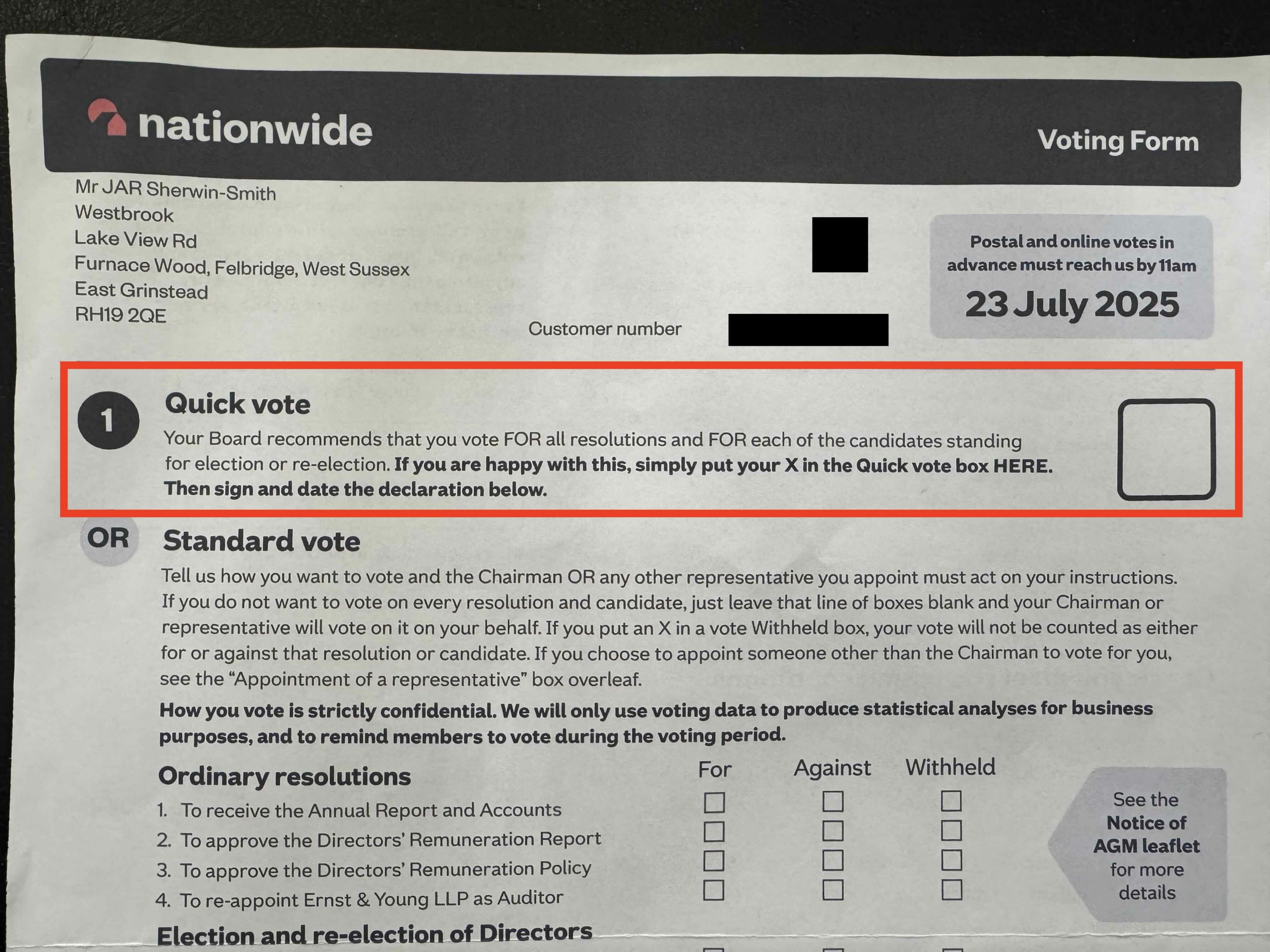
The Quick vote conundrum
If I am successfully nominated, and therefore I appear on the ballot, it is unclear whether Nationwide will use the Quick vote. Since its introduction in 2006, there hasn’t been a member nominated candidate on the ballot to make the election of directors contested.
My election success, and my £500 deposit, may hinge on its use.
[Version 3 – updated 20:00 Sunday 29th March. My thanks to all who have provided feedback.]
James Sherwin-Smith
Independent, Member Nominated Candidate
Skills and experience
James Sherwin-Smith has worked in financial services and payments for over 20 years and has been a director of several UK companies. He previously served as CEO of Growth Street, an FCA-regulated firm that helped UK small businesses access fair and competitive lending.
James later joined Vocalink, the company that operates much of the UK’s core payments infrastructure, including Bacs, Faster Payments and LINK. Following Mastercard’s acquisition of Vocalink, he was part of the leadership team responsible for expanding the company’s payment systems internationally.
He now advises and invests in early-stage financial technology and payments businesses.
Election address
I am standing for election to ensure Members have a meaningful say in how Nationwide is run – and greater transparency into how its decisions affect them.
Like many Members, I value the role that building societies play in the UK financial system. As they are owned by their customers, they are uniquely placed to act in the interests of the people they serve, without the pressure of external shareholders.
This model only works if Members are informed and actively engaged. Mutual societies depend on participation to ensure Members’ interests are properly reflected in Board decisions. Nationwide has over 16 million Members, yet only 4% take part in the Society’s annual elections, and much fewer attend the AGM.
Millions more Members are now joining Nationwide from non-mutual Virgin Money as part of the largest acquisition in building society history. The integration will take years – and there will be tough decisions ahead.
I believe the Board would benefit from having a Member Nominated Director whose role is to ensure Members’ perspectives are consistently considered in major decisions – from strategy to pricing, products, service and Member benefits.
My professional background means I understand how complex financial institutions operate. Through my work in payments infrastructure, and as CEO of an FCA-regulated business, I have seen how organisations can balance commercial success and do the best for their customers.
If elected, my role will be straightforward: to bring an independent, informed Member perspective into the Boardroom and ensure that the voices of all Members are heard where decisions are made, by focusing on three priorities:
- Strengthening how Member’s views are reflected in Board decisions
- Improving transparency, so Members better understand key decisions and how they are affected
- Helping ensure the benefits of mutual ownership – such as pricing, products, service and rewards – are clearly delivered and fairly shared.
Nationwide has been successful because Members trust it to operate differently from shareholder-owned banks. Protecting and strengthening that trust is essential to its future.
Voting
If you would like to see a Member Nominated Director on the Nationwide Board, please vote:
FOR James Sherwin-Smith.
To learn more about me and my views please visit:
James4Nationwide.co.uk
Focus on making the case more specific and urgent. At the moment it’s credible but quite general – add one or two concrete examples of what “better member voice” would actually mean in practice, and explain clearly why now Nationwide needs a member-nominated director. Most members will default to board-backed candidates, so you need a sharper reason to choose him.
Tighten the language and reduce repetition around “member voice/engagement,” and include one punchy line that answers: what changes if I vote for you? Keep the tone constructive, avoid procedural points like the Quick Vote, and end with a clear, direct call to action.
Thanks Tim – these are excellent points. I’ll review in light of these and others feedback.
Hello,
Good luck with your election address. The Nationwide urgently needs an independent board Member. I have told my MP Peter Kyle, that Nationwide could give them an egg on the face problem, much like the post office if Nationwide doesn’t become more accountable to its members.
Thanks Jim – I appreciate the support, and I share your concerns.
I agree with Tim, it needs a call to action by members and I would both start and finish with it. I also agree about the examples and making the language less technical and repetitive. I don’t know who votes at the moment, but I suspect it is more financially aware people. I hope you can bring in more member’s votes by addressing those with less knowledge in simple terms.
Thanks Peter – I’ve now updated it, hopefully it’s an improvement.
Typo in election address line 1. Members not embers
Fixed – thanks Chris!
I also agree with the above comments, it needs to be a bit more punchy. It would be good to have a member director, but perhaps it is actually important to have one.
Thanks Paul – trying to strike the right balance here in terms of making it stand out while at the same time appealing to all. I’ll think some more on this.
The Quick Vote is a shortcut that undermines proper democratic process, and is being abused in other mutual institutions, most notably the National Trust. Its use to elect board members should be outlawed. I would also want my Member nominated director to speak directly to the excessive remuneration package of the CEO. This is not JP Morgan: it’s a mutual bank/building society, and we should not be paying multiple millions to someone to lead it.
That really needed saying. It could be the point to falvanise voters into supporting James.
Thank you Philip & Sandie. I also view the Quick vote as problematic. I am also concerned – like many members – regarding executive pay. It’s something I’ve written about quite a bit – particularly in the lead up to the AGM last year.
e.g. I was grateful to Kalyeena Makortoff for this write-up published in The Guardian last year, and for giving me the last word re binding votes (a right shareholders of listed companies enjoy): https://www.theguardian.com/business/2025/jul/20/storm-brews-over-nationwide-chief-executives-pay-package-worth-up-to-7m
I found the logic espoused by Robin Fieth at the Building Societies Association and Peter Hunt at Mutuo on this point difficult to understand.
A change in the law is not needed for the sector to choose to do the right thing, get with the times and hold binding votes on pay.
To suggest members aren’t suitably “equipped” to determine pay, but are able to vote on accepting published accounts, appoint auditors, elect directors etc. is not only illogical, it’s also verging on insulting. Members either govern their societies or nobody does.
I think the building society, mutual and co-operative sectors should reconsider their stance on binding votes on pay, and ultimately agree to hold themselves to a higher standard.
Looks good to me.
Some 50 years back I was told when being interviewed 1st rule was to ensure I would “fit in”, once in the boat could be gently rocked. I don’t know if you are looking for a salary, if not that would make for an excellent selling point to the members. Whilst unsure if it’s worth mentioning at this stage, without opposition there can be no democracy. Nationwide should be democratically run yet there is no recognisable opposition as the Board simply will not allow, asorry state for any mutual never mind one with 16million member owners. The most senior members of the board can’t even bare to be in the same room as the members/owners.
Thanks Robert. I agree that elections should be contested and member’s should have a choice to make at elections. Competition strikes me as a good way to deliver stronger, democratic outcomes.
If Nationwide wants to become a fully fledged bank, then it should declare its intention and watch the members drift away!
If however it wants to remain as a mutual society for the benefit of its members and not shareholders it should have member representation on the board. Perhaps, in the future there will be more than one, to fully represent Natiionwide’s aspiration to be a trusted community-led financial institution.
Thanks Graham. I agree, I think there should be more member nominated directors across mutuals. Between 1993 and 1997, three member supported directors served on the Nationwide board at the same time. Read more here: https://james4nationwide.co.uk/rebels-with-a-cause-standing-on-the-shoulders-of-giants/
You might be interested to learn that one of the UK’s largest mutuals, Co-op Group, has 4 Member Nominated Directors on its board. One of them is stepping in as interim CEO, as the current CEO is stepping down.
https://www.co-operative.coop/about-us/board-and-directors
https://www.co-operative.coop/media/news-releases/shirine-khoury-haq-to-leave-the-co-op-group-kate-allum-appointed-interim
I have the following suggestions:-
Swap the first two paragraphs around and reword the second one as follows:-
Nationwide is owned by its members. As a member, I am standing for election to give members a meaningful say in how Nationwide is run – and how its decisions affect them.
The paragraphs near the end that start to be reconstructed as follows:-
If elected, my role would be simple: to bring an independent, informed Member perspective into the Boardroom, and ensure that the voices of all Members are heard where decisions are made. In this role, I will focus on three priorities:
1. Strengthening how Member’s views are reflected in Board decisions
2. Improving transparency, so Members better understand key decisions and how they are affected
3. Helping ensure the benefits of mutual ownership – such as pricing, products and Member rewards – are clearly delivered and fairly shared.
Thank you Paul. These are good suggestions – I’ll take another pass.