
Nationwide boss faces her moment of truth on £2.9bn gamble (The Times)
Members were never given a say on the mutual’s biggest takeover since it was founded in 1884 — now they are going to see whether it was worth it
Ben Martin, Banking Editor
Sunday May 17 2026, 2.40pm
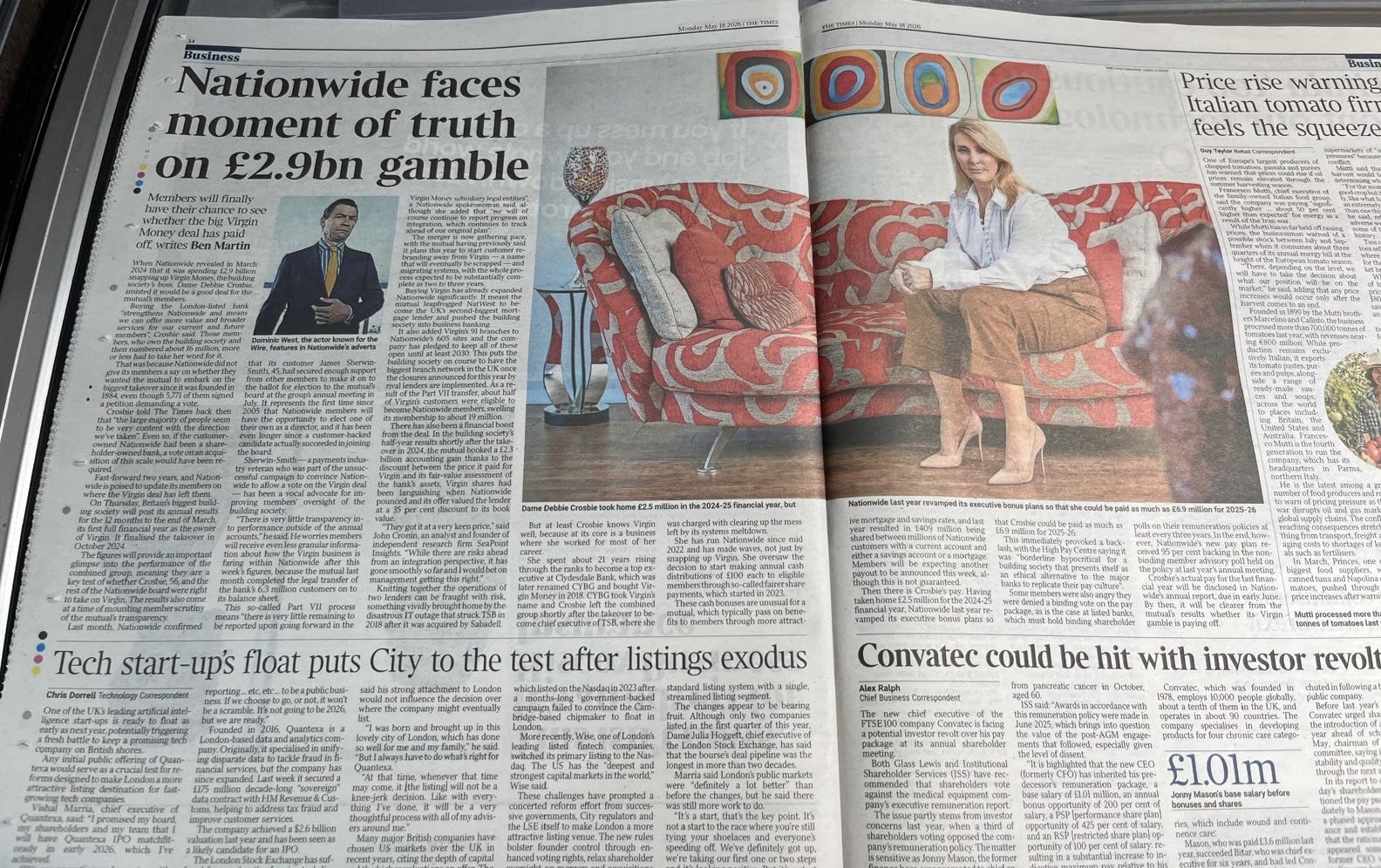
When Nationwide revealed in March 2024 that it was spending £2.9 billion snapping up Virgin Money, the building society’s boss, Dame Debbie Crosbie, insisted it would be a good deal for the mutual’s members.
Buying the London-listed bank “strengthens Nationwide and means we can offer more value and broader services for our current and future members”, Crosbie said. Those members, who own the building society and then numbered about 16 million, more or less had to take her word for it.
That was because Nationwide did not give its members a say on whether they wanted the mutual to embark on the biggest takeover since it was founded in 1884, even though 5,771 of them signed a petition demanding a vote.
Crosbie told The Times back then that “the large majority of people seem to be very content with the direction we’ve taken”. Even so, if the customer-owned Nationwide had been a shareholder-owned bank, a vote on an acquisition of this scale would have been required.
Fast-forward two years, and Nationwide is poised to update its members on where the Virgin deal has left them.
On Thursday, Britain’s biggest building society will post its annual results for the 12 months to the end of March, its first full financial year as the owner of Virgin. It finalised the takeover in October 2024.
The figures will provide an important glimpse into the performance of the combined group, meaning they are a key test of whether Crosbie, 56, and the rest of the Nationwide board were right to take on Virgin. The results also come at a time of mounting member scrutiny of the mutual’s transparency.
Last month, Nationwide confirmed that its customer James Sherwin-Smith, 45, had secured enough support from other members to make it on to the ballot for election to the mutual’s board at the group’s annual meeting in July. It represents the first time since 2005 that Nationwide members will have the opportunity to elect one of their own as a director, and it has been even longer since a customer-backed candidate actually succeeded in joining the board.
Sherwin-Smith — a payments industry veteran who was part of the unsuccessful campaign to convince Nationwide to allow a vote on the Virgin deal — has been a vocal advocate for improving members’ oversight of the building society.
“There is very little transparency into performance outside of the annual accounts,” he said. He worries members will receive even less granular information about how the Virgin business is faring within Nationwide after this week’s figures, because the mutual last month completed the legal transfer of the bank’s 6.3 million customers on to its balance sheet.
There is very little transparency into performance outside of the annual accounts
James Sherwin-Smith
This so-called Part VII process means “there is very little remaining to be reported upon going forward in the Virgin Money subsidiary legal entities”, a Nationwide spokeswoman said, although she added that “we will of course continue to report progress on integration, which continues to track ahead of our original plan”.
The merger is now gathering pace, with the mutual having previously said it plans this year to start customer rebranding away from Virgin — a name that will eventually be scrapped — and migrating systems, with the whole process expected to be substantially complete in two to three years.
Buying Virgin has already expanded Nationwide significantly. It meant the mutual leapfrogged NatWest to become the UK’s second-biggest mortgage lender and pushed the building society into business banking.
It also added Virgin’s 91 branches to Nationwide’s 605 sites and the company has pledged to keep all of these open until at least 2030. This puts the building society on course to have the biggest branch network in the UK once the closures announced for this year by rival lenders are implemented. As a result of the Part VII transfer, about half of Virgin’s customers were eligible to become Nationwide members, swelling its membership to about 19 million.
There has also been a financial boost from the deal. In the building society’s half-year results shortly after the takeover in 2024, the mutual booked a £2.3 billion accounting gain thanks to the discount between the price it paid for Virgin and its fair-value assessment of the bank’s assets. Virgin shares had been languishing when Nationwide pounced and its offer valued the lender at a 35 per cent discount to its book value.
“They got it at a very keen price,” said John Cronin, an analyst and founder of independent research firm SeaPoint Insights. “While there are risks ahead from an integration perspective, it has gone smoothly so far and I would bet on management getting this right.”
Knitting together the operations of two lenders can be fraught with risk, something vividly brought home by the disastrous IT outage that struck TSB in 2018 after it was acquired by Sabadell.
But at least Crosbie knows Virgin well, because at its core is a business where she worked for most of her career.
She spent about 21 years rising through the ranks to become a top executive at Clydesdale Bank, which was later renamed CYBG and bought Virgin Money in 2018. CYBG took Virgin’s name and Crosbie left the combined group shortly after the takeover to become chief executive of TSB, where she was charged with clearing up the mess left by its systems meltdown.
She has run Nationwide since mid 2022 and has made waves, not just by snapping up Virgin. She oversaw the decision to start making annual cash distributions of £100 each to eligible members through so-called fairer share payments, which started in 2023.
These cash bonuses are unusual for a mutual, which typically pass on benefits to members through more attractive mortgage and savings rates, and last year resulted in £409 million being shared between millions of Nationwide customers with a current account and either a savings account or a mortgage. Members will be expecting another payout to be announced this week, although this is not guaranteed.
Then there is Crosbie’s pay. Having taken home £2.5 million for the 2024-25 financial year, Nationwide last year revamped its executive bonus plans so that Crosbie could be paid as much as £6.9 million for 2025-26.
This immediately provoked a backlash, with the High Pay Centre saying it was “borderline hypocritical for a building society that presents itself as an ethical alternative to the major banks to replicate their pay culture”.
Some members were also angry they were denied a binding vote on the pay package, as is the case at listed banks, which must hold binding shareholder polls on their remuneration policies at least every three years. In the end, however, Nationwide’s new pay plan received 95 per cent backing in the non-binding member advisory poll held on the policy at last year’s annual meeting.
Crosbie’s actual pay for the last financial year will be disclosed in Nationwide’s annual report, due in early June. By then, it will be clearer from the mutual’s results whether its Virgin gamble is paying off.