
Members, customers and consumers: why the language of mutuality matters
Words matter. Not because of political correctness or branding, but because they reveal how we understand institutions.
That thought occurred to me as I read the Building Societies Association’s recent strategy output, Finance for a Fairer Future, and the accompanying papers commissioned from a range of professional advisers.
The documents set out a compelling vision for the future of the mutual sector, covering everything from technology and artificial intelligence to regulation, housing and workforce development.
Yet they also reveal something else. Throughout the papers, the language moves between three terms: Members, consumers and customers. Sometimes the distinction is important and deliberate. At other times the terms appear to be used almost interchangeably.
That may seem a minor point. I don’t believe it is. It appears to be a deliberate strategy of the Building Societies Association (BSA) to start to use “customer-owners” rather than Members.
When I challenged the BSA as to why – it argued that the language was deemed more accessible, as many people didn’t understand what “Member” means. It appears that the Building Societies Association – the industry’s own trade body – is pandering to the lowest common denominator, rather than educated people on what makes the sector distinct.
Three different relationships
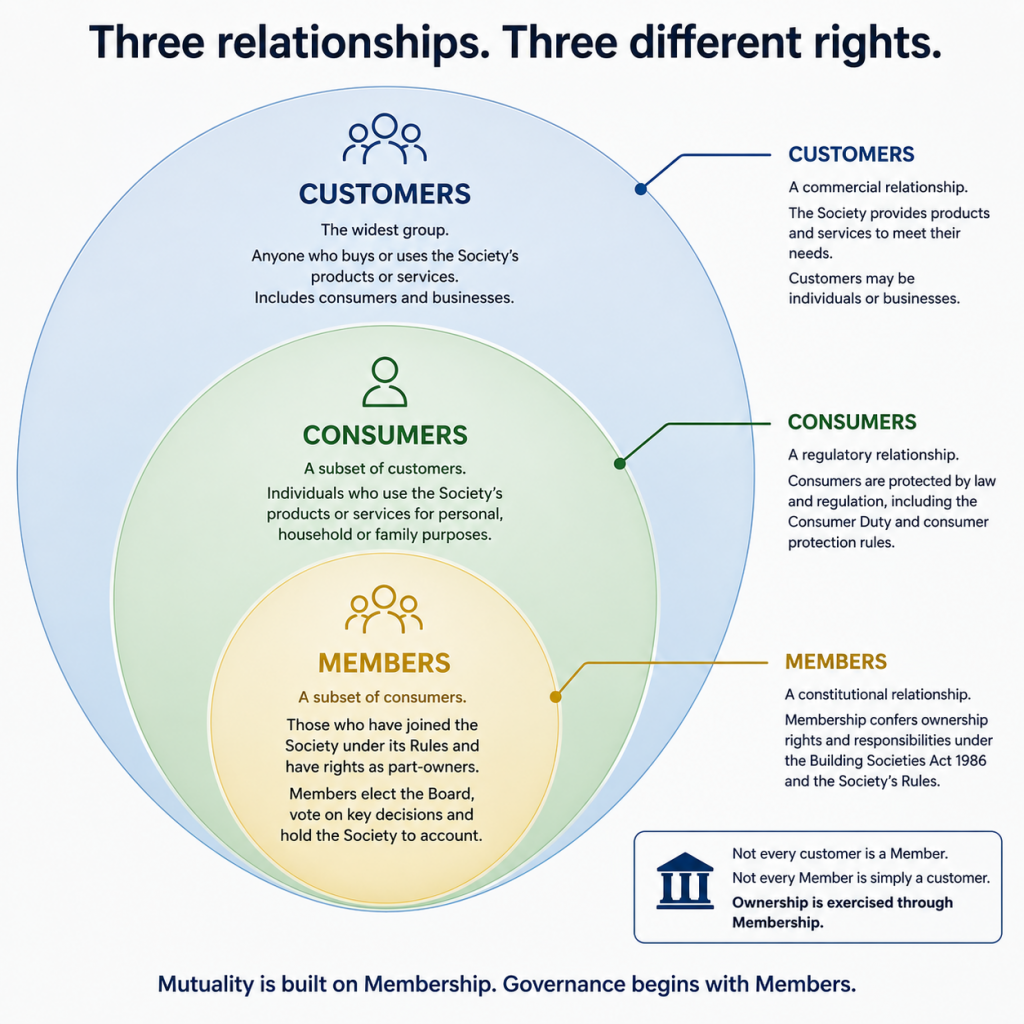
A building society has customers, it may serve businesses as well as consumers (individuals) — some of who are Members.
Those are not three different words describing the same people. They describe three different legal and constitutional relationships.
A customer is someone who buys or uses those products and services. Customer service, customer journeys and customer experience are all entirely appropriate expressions when discussing the commercial relationship between an individual and their financial institution. Customer includes consumers (i.e. individuals) and businesses.
A consumer is a subset of customers, and is a term used by regulators and legislators to represent individuals. Consumer protection law, Consumer Duty and consumer rights all exist to ensure fair outcomes for individuals when selecting financial products and services.
A Member is a further subset of consumers. A Member is an individual owner of a mutual organisation.
Member status carries rights and responsibilities which extend beyond the purchase of financial services:
- Members elect Directors.
- Members vote on constitutional changes.
- Members hold the Board accountable.
- Members exercise rights conferred by the Building Societies Act and by the Rules of their Society.
Those rights exist because of membership, not because someone happens to hold a savings account or mortgage.
Mutuality is more than a business model
The Building Societies Association rightly argues that trust, purpose and long term thinking are among the greatest strengths of the mutual sector. I agree.
But those qualities are not simply cultural aspirations. They are rooted in the constitutional structure of a building society.
A bank is ultimately accountable to its shareholders. A building society is accountable to its Members.
That distinction is not marketing. It is the defining feature of mutuality.
When we describe building societies primarily as “customer owned” institutions, we risk overlooking that constitutional reality. Customers do not own building societies. Members do.
Many customers are Members. Some customers are not. The distinction matters.
Governance begins with ownership
One of the strongest themes in the BSA strategy is governance.
The accompanying papers discuss Board effectiveness, leadership, regulation, artificial intelligence, risk management and accountability. All of these are important.
But governance in a mutual begins one step earlier. Before asking how a Board should govern, we must ask who gives that Board its legitimacy. The answer is Members.
Boards derive their authority from the constitutional relationship between the Society and its Members.
That relationship is what distinguishes a mutual from every other form of financial institution.
Corporate governance and Member governance are therefore complementary rather than competing concepts. One concerns how organisations are directed and controlled. The other concerns how those directing and controlling the organisation remain accountable to its owners.
A revealing sentence
One sentence in the governance paper particularly caught my attention. It suggests that directors should act in the interests of Members “primarily as customers and secondarily as owners”. I understand the point the authors are making. Building societies exist to provide value through products and services, and Members experience that value largely through their interactions as customers.
But I wonder whether the order should be reversed.
Members are owners first. Many also happen to be customers. Their ownership is what gives them constitutional rights. Their customer relationship is one of the ways in which that ownership is expressed.
That distinction is subtle, but important. It reminds us that the purpose of Member democracy is not simply to improve customer experience. It is to ensure that the owners of a mutual remain able to shape its direction, hold its leadership to account and preserve the distinctive characteristics that make mutuality valuable in the first place.
Why this matters
Some readers may conclude that this is simply a debate about terminology. I would argue it is a debate about institutional identity. Language shapes assumptions.
If we consistently think about building societies as customer organisations, governance naturally becomes centred on products, service and operational performance.
If we think about them as Member owned institutions, governance also encompasses elections, accountability, transparency, constitutional rights and democratic participation.
Neither perspective is wrong. Both are necessary. But only one explains why building societies are different from banks.
Keeping mutuality distinctive
The BSA strategy makes a persuasive case for modernising the mutual sector. I share that ambition.
Building societies should embrace innovation, invest in technology, improve efficiency and respond to changing Member needs.
But as they evolve, they should also preserve the constitutional foundations that have made them successful for more than 250 years. Those foundations are built on membership.
Not simply because Members are customers. But because Members are owners.
That distinction is more than a matter of language.
It is the constitutional principle that gives mutuality its meaning.