
The BSA and the Missing Piece: Member Democracy
Why the Building Societies Association’s (and that of major suppliers to the sector) vision for the future of mutuals should put Members at the centre of governance.
The Building Societies Association yesterday published Finance for a Fairer Future, an ambitious strategy setting out a vision for the future of the mutual sector.
It deserves to be widely read.
Drawing together contributions from leading suppliers including Addleshaw Goddard, BCG, Deloitte, EY, KPMG, Microsoft, Odgers, PA Consulting and PwC, the report asks an important question:
How can building societies remain relevant, competitive and true to their purpose over the coming decades?
Its conclusion is clear. Building societies have a tremendous opportunity to grow by helping more people achieve home ownership, improve financial resilience and benefit from a trusted, Member owned alternative to shareholder owned banks.
I welcome that vision.
A strategy built around the future
The report identifies profound changes that will reshape financial services over the coming decades.
Artificial intelligence will transform how financial products are bought and sold.
Home ownership will become increasingly difficult for younger generations.
Financial resilience will come under greater pressure.
Technology will reward scale whilst creating new opportunities for trusted mutual organisations.
In response, the report proposes five broad areas of transformation:
- modernising law and regulation;
- developing new products and services;
- creating a stronger shared identity for the sector;
- increasing collaboration and scale;
- developing the workforce and governance needed for the future.
Much of this is persuasive.
The report rightly argues that mutual organisations should not attempt simply to become smaller versions of shareholder owned banks. Instead, they should build on the characteristics that make them distinctive: long term thinking, trust, regional presence and customer ownership.
Governance matters more than ever
One of the strongest themes running through the report is governance.
The accompanying papers rightly argue that Boards will need broader experience, greater technological capability, stronger strategic thinking and more diverse perspectives.
The Addleshaw Goddard paper is particularly important because it reminds us that the Building Societies Act 1986 does far more than regulate financial institutions. It “hardwires the mutual bargain into law”, making democratic accountability to Members an essential part of what distinguishes a building society from a bank. It describes the principle of “one member one vote” as a defining constitutional feature of the mutual model rather than simply a voluntary governance choice.
That observation deserves greater prominence.
The missing dimension (again)
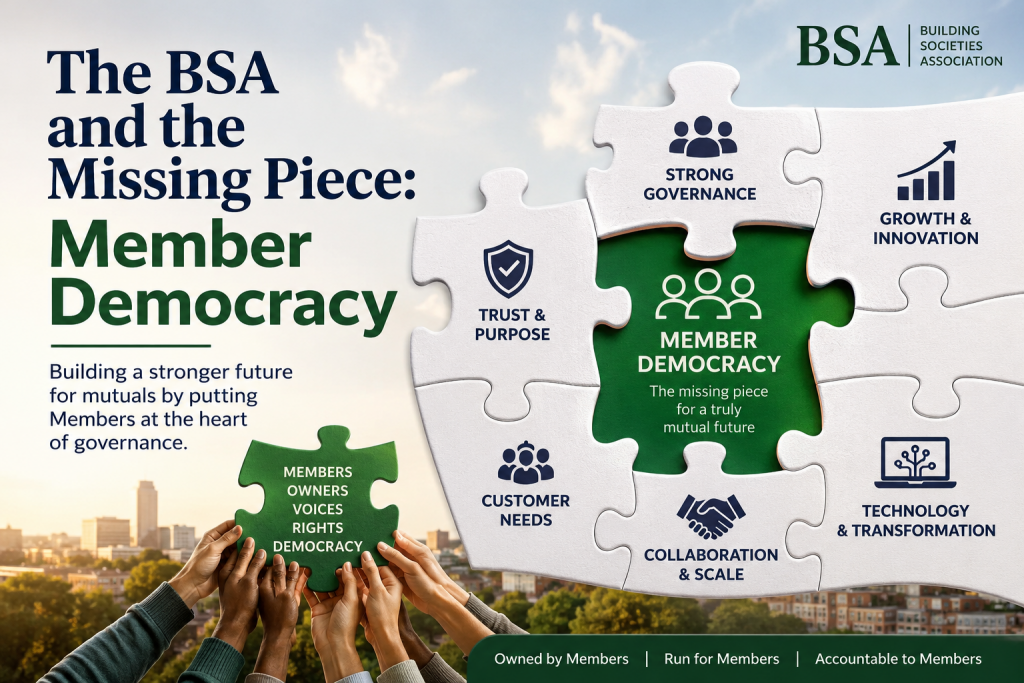
Having read the strategy and its supporting papers, I believe there is one important opportunity to strengthen the conversation further.
The report discusses governance extensively.
However, it does so almost entirely through the lens of:
- Board capability;
- leadership;
- regulation;
- technology governance;
- AI oversight;
- organisational resilience.
These are all important.
But there is comparatively little discussion of Member democracy itself.
That distinction matters.
Corporate governance and Member governance are not the same thing.
Corporate governance asks:
How should organisations be run?
Member governance asks:
How should Members hold those organisations to account?
In a shareholder owned company, governance largely revolves around directors, regulators and shareholders.
In a mutual organisation, governance has an additional constitutional dimension.
Members are not simply customers.
Members are the owners of their Society.
Members elect Directors.
Members approve constitutional changes.
Members possess statutory rights under the Building Societies Act and constitutional rights under their Society’s Rules.
Those rights are what make mutual organisations different.
Words matter
One issue I found particularly interesting was the language used throughout the strategy.
The documents frequently move between the words:
- customer
- consumer
- Member
- customer owned
These terms are often used interchangeably.
In everyday conversation that may not matter.
In a mutual organisation it does.
A bank has customers.
A building society has Members.
Many Members are customers.
Not every customer is necessarily a Member.
Only Members own the Society.
Only Members vote in Elections.
Only Members exercise the democratic rights that distinguish mutual ownership from shareholder ownership.
The report repeatedly argues that trust is one of the sector’s greatest strengths.
I agree.
But trust in a mutual is built on more than products and service.
It is also built on democratic legitimacy.
A natural next step
Rather than seeing this as a criticism of the BSA’s work, I see it as an opportunity to build upon it.
If the strategy is about strengthening mutuals for the future, then strengthening Member democracy should form part of that future too.
As building societies become larger, more technologically sophisticated and more operationally complex, maintaining meaningful accountability to Members becomes more important, not less.
Questions about Board accountability, contested Elections, transparency, Member participation and constitutional rights are not separate from governance.
They are governance.
Indeed, they are what make mutual governance distinctive.
My Four Pillars Framework
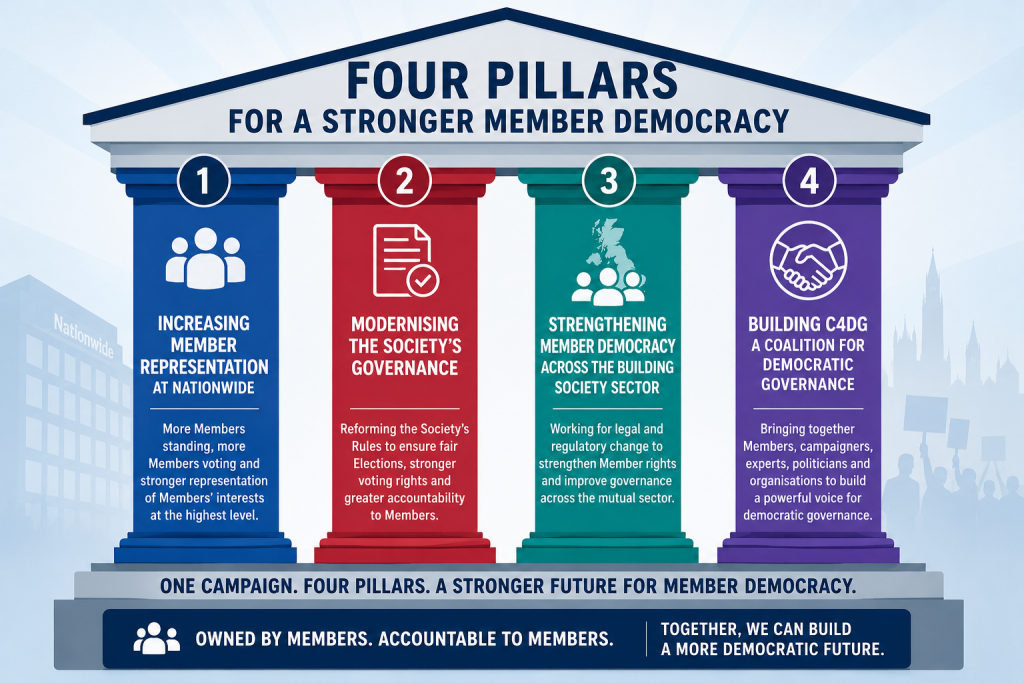
For the past year I have been campaigning for stronger Member democracy within Nationwide Building Society through my Four Pillars framework.
Those pillars seek to strengthen:
- Member rights;
- democratic accountability;
- governance standards;
- transparency and engagement.
Far from conflicting with the BSA’s strategy, I believe they complement it.
The BSA has produced an important roadmap for how building societies can thrive in a changing world.
My contribution is to argue that the future of mutuality should be built not only on technology, capital and innovation, but also on stronger Member democracy.
If we modernise everything else while neglecting the constitutional relationship between Members and their Society, we risk weakening the very feature that makes building societies unique.
Conversely, if we strengthen both governance and Member democracy together, the mutual sector can remain one of the UK’s most distinctive and trusted financial success stories.
The BSA has started an important conversation.
I hope the next stage of that conversation includes an equally ambitious vision for the future of Member democracy.