Executive Pay at Nationwide: When a Member Vote Isn’t Really a Vote
Why the building society’s remuneration vote is advisory, dominated by the Quick Vote, and supported by just 4% of members.
At last year’s AGM, the increased package for the CEO of up to £7m was branded by one member as an “obscenity”, as reported at the time in The Guardian. Private Eye noticed at the time that this was over 275x the pay of the most junior member of staff.
How does this happen? After all, every year, Nationwide members are asked to vote on the society’s Directors’ Remuneration Report at the Annual General Meeting.
At first glance, this appears to give members a say over how much Nationwide’s executives are paid.
But there is an important catch: the vote is NOT binding.
Even if members were to reject the remuneration report, the board would not be required to change anything. Combined with very low participation and the widespread use of delegated voting, this makes it extremely difficult for members to challenge executive pay in practice.
Understanding why helps explain a broader issue about governance at Nationwide — and why member engagement matters more than ever.
Why the vote isn’t binding
At listed companies in the UK, shareholders are given a binding vote on executive pay policy. If shareholders reject it, the company must revise the policy.
This requirement was introduced through reforms to the Companies Act following the Enterprise and Regulatory Reform Act.
However, Nationwide is not a company. It is a building society, governed instead by the Building Societies Act. Because of this distinction, building societies were never required to introduce a binding vote on executive pay.
Nationwide operates with a purely advisory vote on the remuneration report. The society could however choose to hold itself to the same standard as companies and hold a binding vote, but it does not. Members can signal approval or disapproval, but the board ultimately retains full discretion over executive pay.
This significantly weakens one of the main tools that owners of an organisation typically have to hold leadership accountable.
The Quick Vote and the engagement problem
There is another structural factor that further limits scrutiny: Nationwide’s “Quick Vote” system.
The Quick Vote allows members to simply delegate their vote to the Chair to be cast in line with the board’s recommendations. For many members it is an easy and convenient option.
However it also contributes to a broader cycle of disengagement.
Nationwide has around 16 million members, yet participation in AGM voting has gradually fallen to around 4% of the membership (only 0.6 million members vote). Of those who do vote, the vast majority use the Quick Vote.
This means that a very large proportion of votes are effectively pre-aligned with the board’s recommendations.
In this context, it becomes extremely difficult for members to use the AGM vote to signal meaningful concern about issues such as executive pay, and over time, members are increasingly disengaged.
What the voting history shows
Nationwide introduced a vote on the remuneration report in 2003. In the first few years, approval levels were just above 80%, which is broadly typical for governance votes.
But approval levels fell to below 75% in 2005 – and the very next year, Nationwide introduced the Quick Vote system.
From that point onwards, approval rates increased sharply and have typically sat around 95% or higher. The only meaningful dip occurred in 2012, following a period of media scrutiny of executive pay.
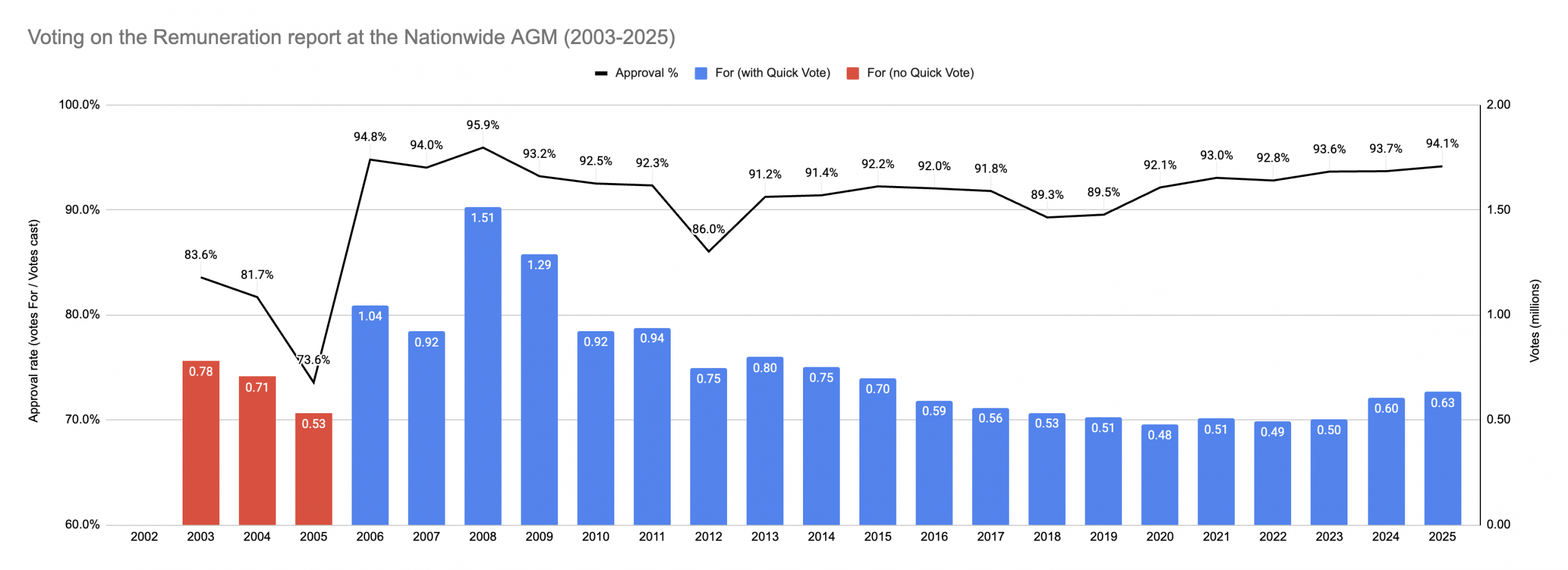
The pattern is difficult to ignore: once a large share of votes are automatically delegated to the Chair, the outcome of governance resolutions becomes largely predictable.
Why this matters for a mutual
Executive pay is not just a technical governance issue. Nationwide is a mutual organisation, owned by its members rather than external shareholders. In theory, that should mean stronger democratic oversight, not weaker.
Yet the current environment means:
- The vote on executive pay is advisory rather than binding
- A large proportion of votes are delegated back to the board
- Participation among members is extremely low relative to the size of the membership
Taken together, these factors make it very difficult for members to exert meaningful influence over remuneration decisions.
This matters particularly when executive pay is often justified by comparison with large listed banks.
However Nationwide is fundamentally a simpler institution. It does not operate large investment banking divisions or extensive corporate banking businesses, and it does not face the same shareholder pressures as a listed bank.
Members should therefore expect greater transparency and accountability, not less.
Two simple reforms
None of this is inevitable: two simple fixes could make a massive difference.
- Nationwide could strengthen member democracy through a relatively straightforward reform: introducing a binding member vote on executive pay policy. This would make the society and its board more responsive to member concerns if a remuneration policy fails to win sufficient support.
- Equally important, governance votes that genuinely matter should not be dominated by automatic delegated voting via mechanisms like the Quick Vote.
Building societies were created to give savers and borrowers collective ownership and control of their financial institutions.
If that principle is to remain meaningful, members need real tools to hold boards and executives accountable.
A binding, unguided vote would be a good place to start, as called out by Nils Pratley writing in The Guardian: Nationwide building society’s members deserve real votes.