
The Information I Wanted to Give Members Before They Vote
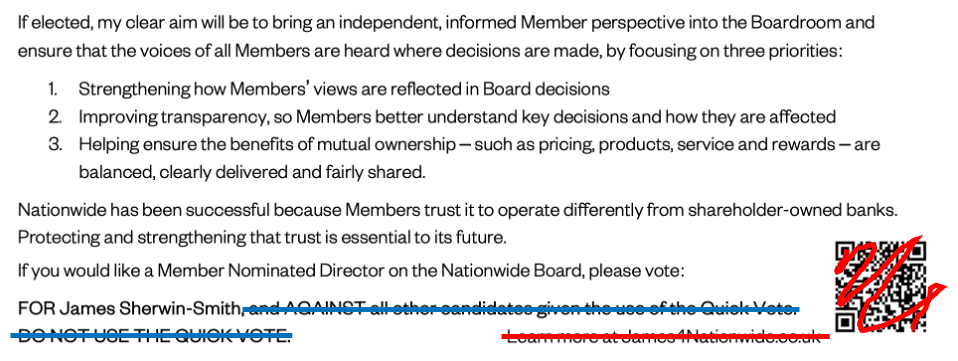
The last section of my revised Election Address. The Society has made the redactions in red and blue, for different reasons, against my wishes. 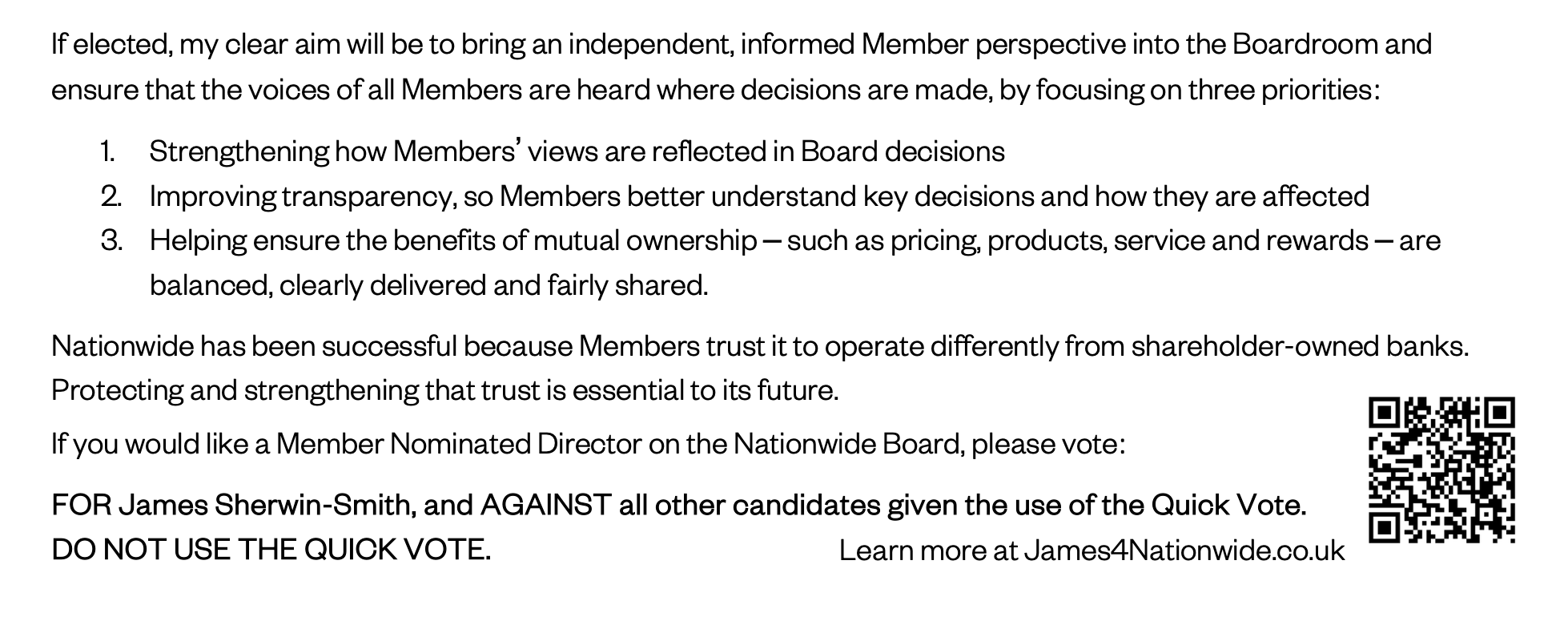
The last section of my revised Election Address, provided in advance of the Society notifying me of the Board’s decision. 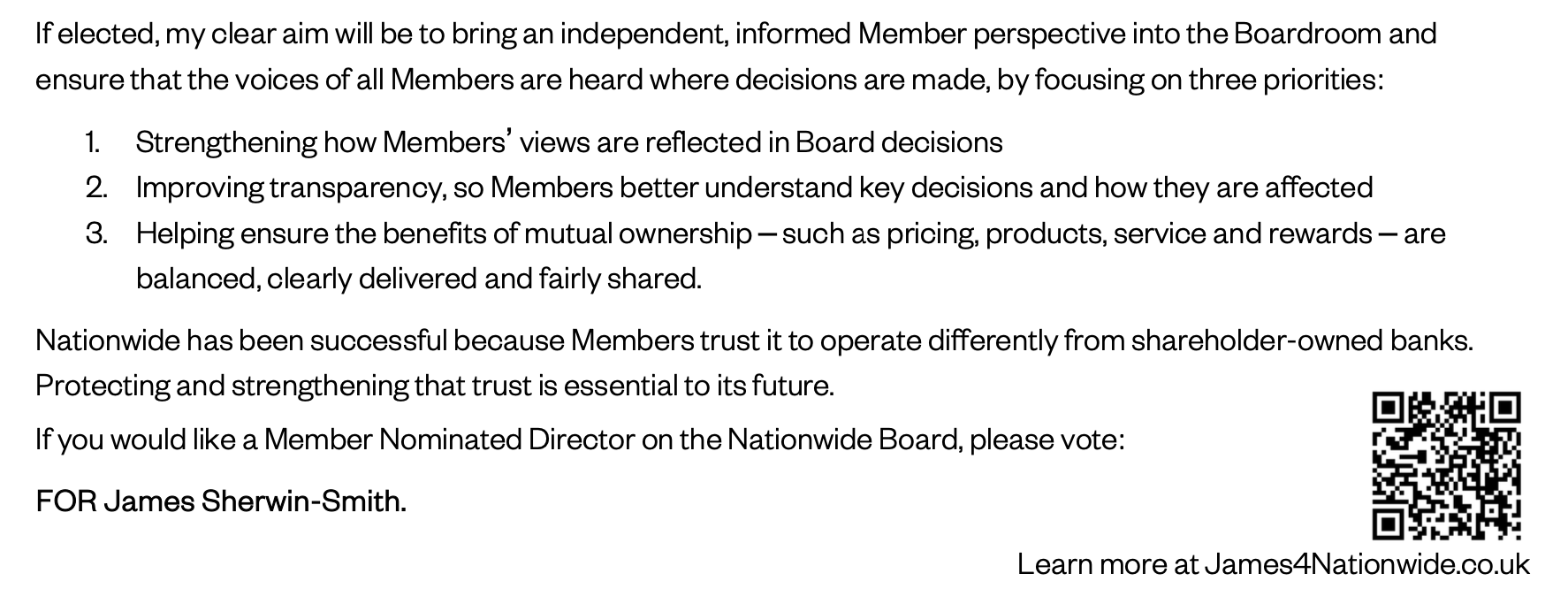
The last section of Election Address (submitted on the expectation that the Quick vote would be suspended, while requesting that it be amended if not)
[↩️ Mobile users may want to rotate to landscape viewing, or click images to see full size: Society redactions, my alternative and my original Election Address.]
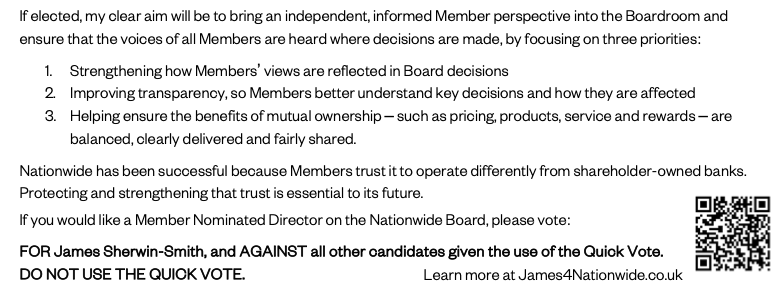
As voting papers begin arriving with Nationwide Members, I believe it is important to explain a dispute that has arisen between myself and Nationwide regarding my Election Address and the information available to Members ahead of this year’s Board election.
I want to set out the facts as clearly as possible, so that Members, journalists, Parliamentarians and others can draw their own conclusions.
Why this matters
This year’s election is unusual. I am the only Member Nominated Candidate standing for election to the Nationwide Board – and the first at Nationwide for over 20 years. Unlike the other candidates, I was nominated directly by Members rather than selected through the Board’s appointments process.
Whatever Members think of my candidacy, I believe they should have access to sufficient information to make an informed choice.
The disagreement concerns whether Members are receiving all of that information.
The background
On 30th March 2026, I submitted my Election Address to Nationwide for inclusion in the AGM voting materials, alongside a cover letter, my nomination forms and my £500 deposit cheque.
One section of my cover letter addressed the Quick vote specifically and the basis on which I had prepared by Election Address:
Use of the Quick vote
There has not been a member nominated candidate on the ballot since 2005. Since that time, the Society has adopted the “Quick vote” mechanism. If I am a board recommended candidate, I can see that I may be a beneficiary of such a mechanism. However, if I am not a recommended candidate for any reason, I see that using the mechanism would be highly detrimental to the chances of my successful election. I would therefore humbly request that, in the interests of fairness, the Society suspends the use of the Quick vote for all directors at this election, particularly if I – or any other candidate – is nominated.
I have written my election address on the basis that the Quick vote is suspended. If it is not, I request the right to revise my address accordingly.”
Cover letter submitted and acknowledged same day by the Society, 30 March 2026
The Society acknowledged receipt of that submission the same day.
My Election Address included two references to my campaign website, James4Nationwide.co.uk, together with a QR code (for convenience as many Members receive paper material through the post) directing Members to the same website for further information about my candidacy and campaign.
Over the following two months, no concerns were raised by the Society with me regarding those website references or QR codes.
At interview with the Board Nominations Committee on 20th April we agreed a minor typographical correction that both sides had spotted: I erroneously referred to Growth Street, where I held CF1 and CF3 roles as per the FCA register) as a “FCA regulated” rather than a “FCA registered” business.
During this period, I repeatedly made clear to Nationwide – including in- person with members of the Board Nominations Committee and the Society Secretary – that if the Board decided to retain its “Quick vote” system, I would like the opportunity to update my Election Address accordingly. This shouldn’t have been any surprise to the Society: in 2025 I included similar language in my cover letter and also submitted two separate versions of my Election Address.
The Board’s decisions
On 28th May 2026, Nationwide informed me of two important decisions, in a phone call (I kept a verbatim transcript) with the Society Secretary:
- The Board is not recommending my candidacy to the Members.
- The Board would continue using the Society’s Quick Vote system, and that this will result in a vote Against my election.
This was significant because under Nationwide’s voting arrangements, Members who use Quick Vote cast votes in line with the Board’s recommendations. The Society has disclosed that 87% of Members used the Quick Vote last year.
In practice, this biases the election significantly against me – as envisaged in the cover letter segment above.
The amendment I requested
On the same call, after I was notified of the Board’s decision, I again asked Nationwide for permission to make a short amendment to my Election Address, as I had several times in writing and in person over the prior 2 months. Prior to the call, I had sent the Society a different version of my address with the edits made, fearing this outcome, given the length of time the Society had taken to relay the Board’s decision (prompting this article printed in that morning’s edition of The Times).
The purpose of a short addendum was straightforward, fearing this would be a contested election and the Quick vote would be used (not anticipating it would be uncontested, but the Quick vote would “weaponised” by generating votes Against me):
, and AGAINST all other candidates given the use of the Quick Vote. DO NOT USE THE QUICK VOTE.
18 word addendum to my Election Address in the event the Quick vote is not suspended
Note that the addendum meant my Election Address still did not exceed the 500 word statutory limit. I wanted to explain to Members that if they wished to support my candidacy, they should not use Quick vote and should instead vote for me directly, and to enhance my chances of success anticipating this would be a contested election (i.e. I would need more For votes than the last placed board candidate to be elected), to vote Against Board candidates. [To better understand the impact of the different permutations of the Board’s decisions, see this Google Sheet which models these.]
I believed this was important information given the Board’s decision and the practical operation of the voting system. Perhaps even more so given the Board’s choice to use the Quick vote to generate votes Against my candidacy.
Nationwide refused my addendum. And the Society also disclosed it was going even further.
Changes made by Nationwide
On the same call, Nationwide informed me that it had removed the QR code and website addresses that formed part of my submitted Election Address, without my permission.
The explanation initially given to me by the Society Secretary was that Nationwide could not control what Members might see if they followed those links.
I have subsequently sought clarification regarding the basis on which the Society considered itself entitled to remove part of the material I had submitted.
Nationwide explained that it considered it inappropriate to direct Members to content over which the Society had no control and that it was not required to include website addresses or QR codes within the election materials.
However, at the time of writing, I am still seeking clarification regarding the legal or constitutional basis upon which the submitted material was altered. The law clearly states that a “copy” of the election address should be distributed to the Members (see Member Nominated Candidate calls on FCA to review election fairness ahead of 2026 AGM voting form distribution).
Why I contacted the FCA
Because I believed these issues raised important questions about the presentation of my candidacy to Members, I contacted the Financial Conduct Authority (FCA), which regulates building societies. I am also acutely aware of the precedent that might be set here for any future Member Nominated Candidates in the sector – Nationwide is the largest building society, and others often follow its lead when breaking new ground.
I asked the FCA to consider concerns relating to:
- the continued use of the Quick Vote when a Member Nominated Candidate is successfully nominated;
- Nationwide’s refusal to allow me to update my Election Address following the Board’s decision;
- the removal of website links (given at the top and bottom of my Election Address) and a QR code from my submitted election materials
- the absence of proof election materials that would allow me to understand the impact of the changes – I am still in the dark as to how I will appear on the ballot and in the associated materials
- procedural fairness and natural justice.
After reviewing extensive evidence provided by me, FCA has since confirmed to me that it has considered aspects of the concerns raised and it is not taking action.
The FCA has also confirmed that it has not treated my correspondence as a request for a determination under Section 61(9) of the Building Societies Act (1986) despite my invitation for them to do so and has stated that it has not identified evidence that Nationwide’s approach breaches the relevant legislation or rules.
The FCA has further confirmed that Nationwide is not seeking to rely on Section 61(8)(a) of the Act in relation to the removal of the QR codes and website links – effectively rendering my invitation under Section 61(9) moot.
I am continuing to seek clarification from the Society, with the FCA copied, regarding the basis on which elements of my Election Address have been removed by the Society.
Why I believe this matters
This issue is not really about QR codes and web addresses. Nor is it fundamentally about my candidacy.
The broader question is whether Members of a mutual organisation should have a genuine opportunity to receive information from an independent candidate standing for election to the Board.
It is also about whether Members understand how the voting system operates before casting their votes.
I believe Members who wish to support my candidacy should be suitably informed not to use the Quick Vote, and that this should be evident from reading my Election Address.
Further, Members should have the opportunity to learn more about me, my candidacy and concerns, and have the ability to contact me directly with any questions or perspectives that they might have – hence a link to my website. Note that my Election Address will form part of the Notice of AGM materials, and therefore circulated to millions of people, and publicly made available on the Society’s website – so a website address struck me as the most appropriate contact method given the scale involved.
That is why I wanted to make a small addendum regarding the “Quick vote” and voting instructions, and why the integrity of my distributed Election Address (i.e. without redactions not authorised by me) is so important.
Members may have different views on how the Society should have acted in this case.
Let the Members decide – with more information, not less
I have tried throughout this process to engage constructively with fellow Members, Nationwide and the FCA.
I respect that others may take different views from my own.
My purpose in writing this article is not to tell Members what conclusion to reach.
Rather, it is to ensure that the facts are available so that Members, journalists, Parliamentarians and other interested observers can assess the situation for themselves.
Whatever your views on my candidacy, I encourage every eligible Member to:
- read the voting materials carefully;
- understand how Quick Vote operates;
- consider all candidates on their merits; and
- make an informed choice.
Ultimately, Nationwide belongs to its Members.
The decision should be theirs – albeit with unfettered access to the information made available by candidates to support them in making their determination.
James Sherwin-Smith
Member Nominated Candidate for Election to the Board of Nationwide Building Society
James4Nationwide.co.uk
5 thoughts on “The Information I Wanted to Give Members Before They Vote”
Comments are closed.
I’m responding to the guide on voting and would like to know what difference it will make to vote against all other board members, as suggested, in order to show more support for James
Thanks for your question John. I personally will be voting Against the Board members as the decision to use the Quick Vote was unanimous, according to the Society Secretary. I advise Members to do the same.
The refusal to let me amend my Election Address in light of the Board’s decisions was not surprising, but it was disappointing, given my experience to date. See https://james4nationwide.co.uk/timeline
However the unauthorised redactions of my election address is disgraceful in my opinion, and I have asked the FCA to investigate whether the law has broken as a result.
https://james4nationwide.co.uk/nationwide-challenger-asks-fca-to-investigate-after-society-edited-election-address-departing-from-previous-election-practice/