
Fact checking Nationwide’s statement re ’emerging governance issues’
A spokesperson for Nationwide made a series of statements in today’s article in The Guardian reporting of Nav Mishra MP’s letter sent to the Nationwide chairman, Kevin Parry.
I think these statements are worth placing in context – both in terms of the timeline of the pertinent events, and the corresponding data.
I will leave it to Members to draw their own conclusions as to how Nationwide positioned its responses vis-a-vis the facts.
Intro of Remuneration vote (and Quick vote)
“…while pay votes were non-binding, 95% of votes cast were in support of the remuneration policy”
Nationwide spokesperson
Timeline
- 2003: The non-binding i.e. advisory vote on remuneration was introduced, with an approval rate of 84%
- 2004-05: The approval rate subsequently fell for two years running, falling below 74%
- 2006: the quick vote was introduced. The impact of this was that the approval rate for remuneration jumped to c 95%. It has mostly stayed above 90% ever since.
Data
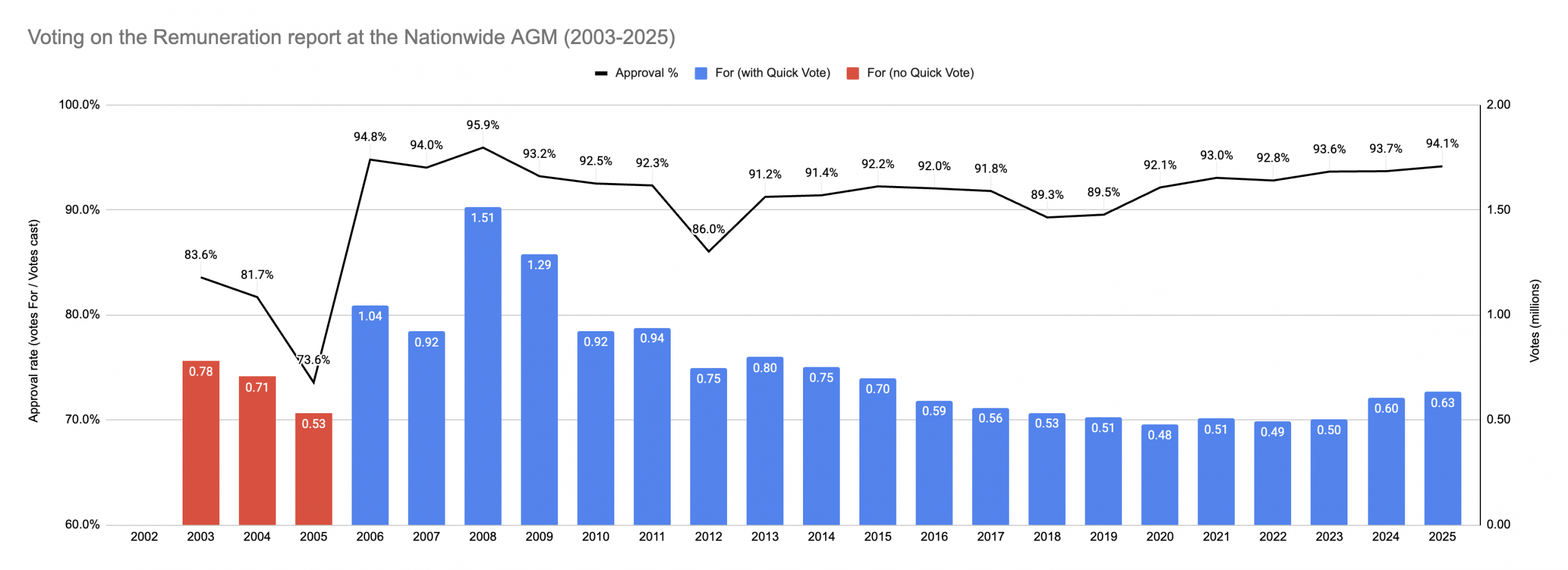
Online-only AGMs
“…online-only AGMs have reversed declining attendance, and was the fairest way to get millions of members to participate”.
Nationwide spokesperson
Timeline
- Since at least the year 2000, Nationwide has allowed Members to join its AGM online. Nationwide has for a long time therefore operated hybrid AGMs – allowing Members to join online and physically, in-person.
- In 2007, Nationwide introduced electronic voting – members no longer had to submit voting forms via post or attend the AGM to cast their vote in person.
- in 2020, the prior chairman, David Roberts, requested that Members support a change to the rules to allow virtual-only AGMs during the COVID-19 pandemic, stating at the time: “I would like to stress that, unless there are exceptional circumstances, the intention will be to hold a combination of both physical and online meetings and not an exclusively virtual or online meeting.“
- In 2022, the current chairman Kevin Parry stated: “This year, the Society held its first hybrid AGM“
- In 2024, Nationwide moved to a virtual-only AGM, with Kevin Parry stating: “This AGM is fully online and builds on our experience from last year. We discovered then that many more people attended online than made it in person, almost ten times as many in fact, and they were just as able to ask questions and vote as the people who were in the room.”
For more info, see Debasing the membership (part 1): Nationwide’s virtual-only AGM.
Data

- Nationwide had the highest AGM attendance when the Society chose to host it in London. When the Society chose to take the AGM to regional cities, attendance was considerably less.
- Attendance unsurprisingly was de minimus during the pandemic (2020-21)
- When you take into account Kevin Parry’s rule of thumb — that ~10x people attend in person vs online — AGM attendance is down since it was made virtual-only, it is down considerably vs pre-pandemic meetings, and attendance is now less than when the Society chose to hold the AGM in London (counting physical attendees alone) when attendance was 500 people or greater (and noting the Society had significantly fewer members)
Use of the Quick Vote outside of the Building Society sector
“All building societies and listed companies use similar quick vote or proxy voting systems.”
Nationwide spokesperson
There is a considerable difference between the “quick vote” and proxy voting systems
- supporting the appointment of a representative to vote on your behalf (i.e. a proxy vote) is common within electoral procedures, including political and corporate elections
- the use of an asymmetric voting system like the quick vote gives power solely to the chair to vote the board’s recommendations. Its use has increased over time within member-owned organisations. Comparable block-voting mechanisms are prohibited in trade union executive elections, where legislation requires votes to be cast directly for individual candidates.
Further, to suggest or interpret that all listed companies make use of a quick vote system is false.
Last of all, Courts have previously warned against voting mechanisms that risk entrenching incumbent directors.
So for the avoidance of doubt, let me suggest a rephrasing that would aid accuracy and comprehension:
All building societies and listed companies support proxy voting, while some organisations like Nationwide also choose to use a controversial ‘quick vote’ system.
James Sherwin-Smith
2 thoughts on “Fact checking Nationwide’s statement re ’emerging governance issues’”
Comments are closed.
What is the potential hourly rate for Nationwides CEO. I can’t think of anyone working 365 days of the year but if she did thats a tad over £19,000 per day most of which is in bonus’s for achieving “stringent targets” which are not disclosed to the owners of the business. At that rate please Lord forbid her putting the kettle on or going to the loo. Perhaps she might reveal her cost to the business for being in attendance for the day of the AGM?