
Mutual suspicion over Nationwide’s ballot (The Times)
James Sherwin-Smith, a member-nominated candidate for the board, is crying foul about the way the building society is organising the vote
By Ben Martin
Thursday June 04 2026, 8.50pm, The Times
Ask Dame Debbie Crosbie, chief executive of the customer-owned Nationwide Building Society, whether the mutual is open to members joining its board and her answer is unequivocal. “We are very encouraging of any member engagement, including member-nominated directors,” she said last month. James Sherwin-Smith might disagree.
An outspoken critic of governance at the mutual in recent years, he’s attempting to become the first member-nominated individual in decades to win election to the board of Britain’s biggest building society. Yet Nationwide, it seems, has tilted the playing field against him.
This has, understandably, triggered a rebuke from the tenacious Sherwin-Smith, 45, who has accused the mutual of seeking to “weaponise” its voting system and has complained to the Financial Conduct Authority.
It’s a row that could prove especially damaging for Nationwide, given the emphasis it places on the special relationship its mutual status creates with its member-customers. This is trumpeted on its website, where Nationwide boasts that, unlike shareholder-owned banks, “we are run for, and owned by our members”. Then there are those TV ads featuring the actor Dominic West as an arrogant bank boss that drove home the message the society “puts its members first”.
Yet it’s the Nationwide board, led by chairman Kevin Parry, that looks high-handed with its treatment of Sherwin-Smith, the first member-nominated candidate to make it onto the ballot for a board seat since 2005. It has been even longer since a customer-backed candidate succeeded in becoming a Nationwide director.
There’s nothing wrong with the board’s decision to recommend its members oppose Sherwin-Smith’s candidacy at July’s annual meeting. He’s on the ballot after passing the society’s threshold of securing at least 250 valid nominations from other members. Nationwide has then assessed whether it believes he’s suitable, a process involving two interviews with four of the mutual’s directors. That led the board to conclude the election of Sherwin-Smith, a former management consultant who has worked in payments, would not be in “the best interests of members”.
It believes he lacks the skills for the job, as well as “practical experience of board-level governance or decision making at a building society or mutual, or in any regulated financial services firm of comparable scale and complexity as Nationwide”.
That’s a fair enough stance to take. After all, Nationwide is Britain’s second-biggest mortgage lender, with 19 million members and £382.3 billion of assets. But in the end it’s the nine million Nationwide members eligible to vote at the annual meeting who will decide whether they want Sherwin-Smith as a director. And the way Nationwide is running the vote puts him at a disadvantage.
For two decades it has offered members a “quick vote”, allowing them to tick a single box to vote in accordance with the board’s recommendations on all resolutions, a quicker alternative to voting on each measure. This year’s meeting, however, is the first time since the quick vote has been used that there is a member-nominated candidate without the board’s blessing. Given Nationwide’s recommendation on Sherwin-Smith, members who use this time-saving mechanism will be voting against him, prompting him to argue this creates an “unfair fight”.
He’d asked Nationwide not to use the quick vote this year and had written his election address on the assumption it would accept his request. But it didn’t, and the mutual has also told him that under the Building Societies Act he cannot update his address, which will shortly be sent to members.
No wonder, then, that he’s crying foul. He failed to make it onto the ballot last year when Nationwide disqualified some of his nominations. This year it also found that about 90 were invalid, although he still scraped through.
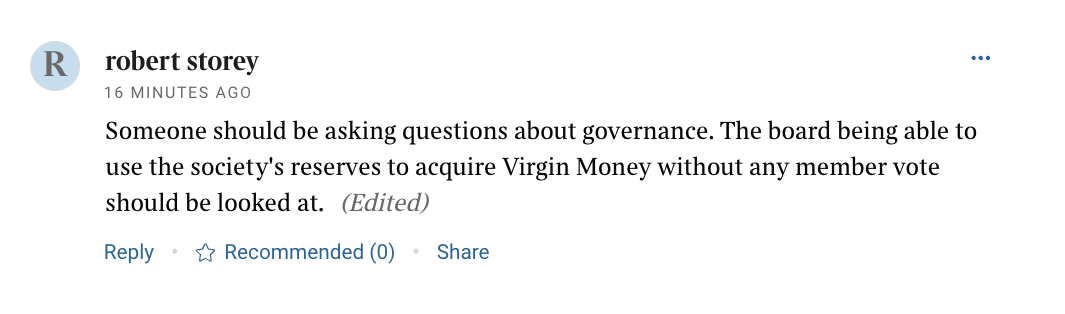
It creates the impression that despite what Crosbie says, Nationwide is hostile to member-nominated board candidates. Add the fact that the mutual denied its members a say on its £2.9 billion Virgin Money takeover two years ago, its biggest ever acquisition, and Nationwide — which says on its annual meeting web page that “we exist for our members” — risks looking like it wants to keep them at arm’s length.
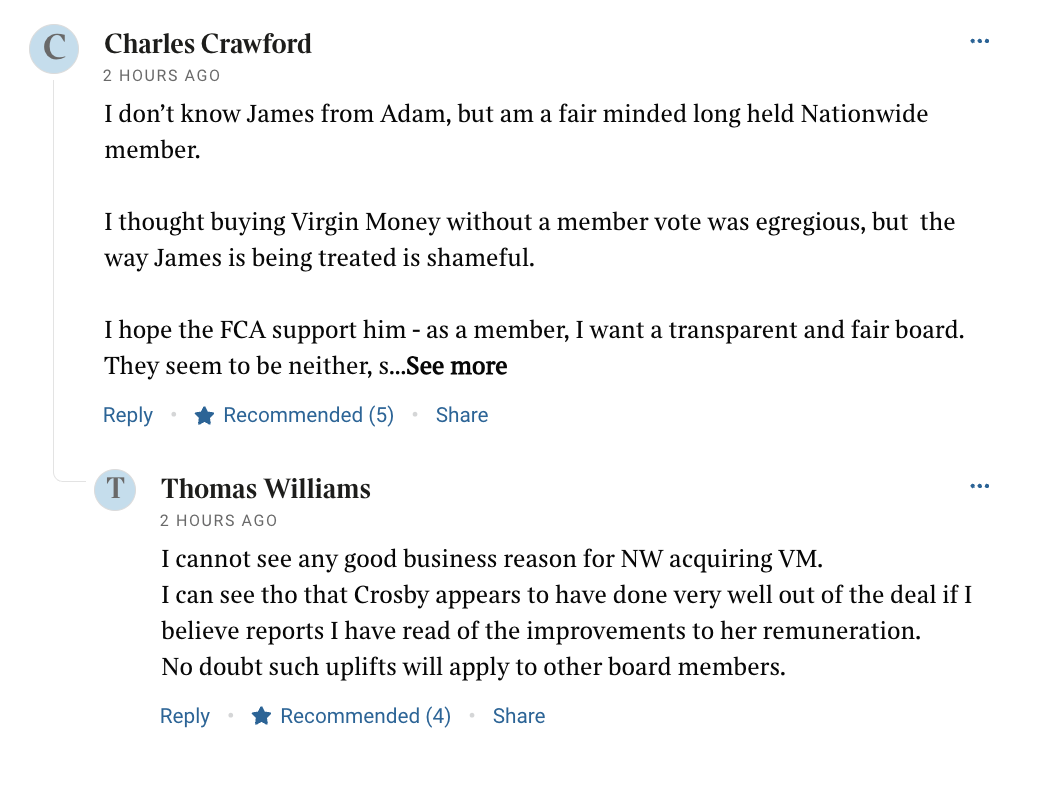
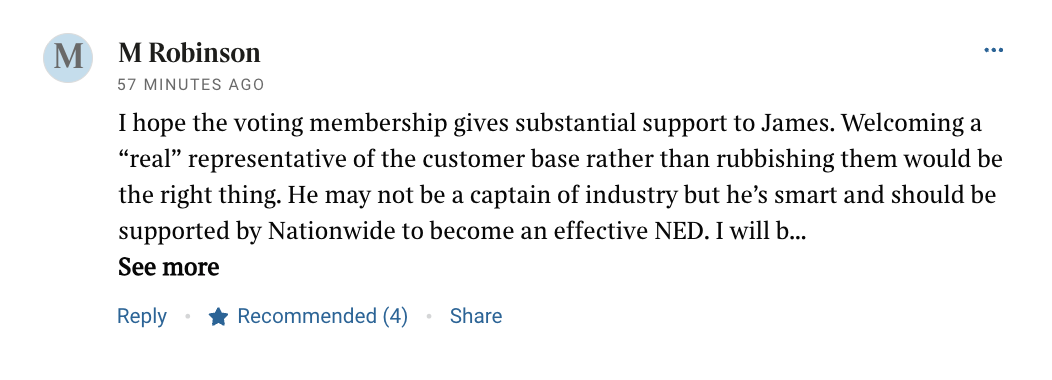
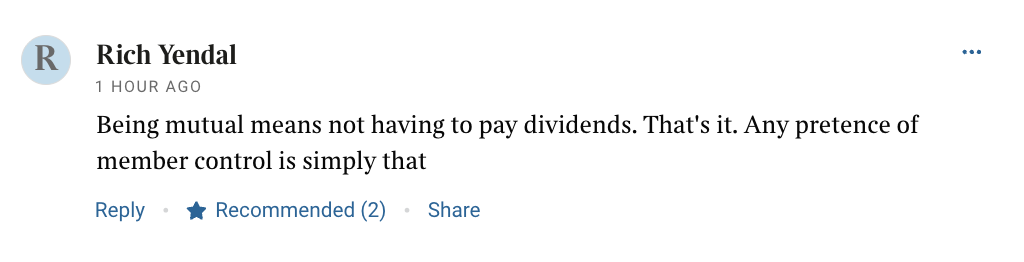
Comments from The Times online as of 09:00 this morning

2 thoughts on “Mutual suspicion over Nationwide’s ballot (The Times)”
Comments are closed.
“Ask Dame Debbie Crosbie, chief executive of the customer-owned Nationwide Building Society, whether the mutual is open to members joining its board and her answer is unequivocal. “We are very encouraging of any member engagement, including member-nominated directors,” she said last month.” Now ask her to name one.
Thank you Robert. I do think it is lamentable that there are so few examples of Member Nominated Candidates, and even fewer Member Nominated Directors, across the building society sector. I hope my efforts, and the response of Nationwide, do not discourage others from also stepping up to represent Members’ interests, increase transparency and accountability.