
Rebel customer faces ‘unfair fight’ for seat on Nationwide board (The Times)
The mutual is urging its members to oppose James Sherwin-Smith, who argues that its ‘quick vote’ system has been deployed against him
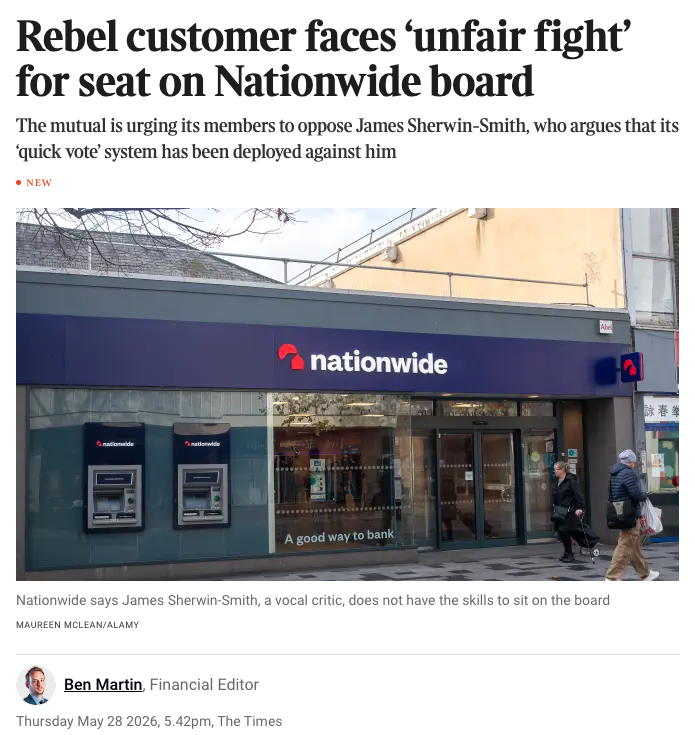
Nationwide says James Sherwin-Smith, a vocal critic, does not have the skills to sit on the board
Thursday May 28 2026, 5:42pm
By Ben Martin, Financial Editor
The rebel Nationwide customer campaigning to join the building society’s board has accused it of orchestrating an “unfair fight” after the mutual urged its members to oppose him.
Britain’s biggest building society said on Thursday it was recommending that its members vote against James Sherwin-Smith’s election as a director at its annual meeting in mid-July because its board had concluded he did not have requisite skills or experience.
Its decision, which follows an assessment of Sherwin-Smith by an executive headhunting firm and two interviews with four board directors, is a blow to the campaigner. He is a vocal critic of Nationwide’s governance and is the first member-nominated candidate to make it on to the ballot for a seat on its board in 21 years.
He said he was “hugely disappointed” with the mutual’s decision and at the way the society was running the vote, which he argued put him at a “structural disadvantage”.
This is because Nationwide, as in previous years, will offer members the option of a so-called “quick vote” that allows them to vote in accordance with all of the board’s recommendations by ticking a single box, rather than voting on each measure in turn.
This year’s election will mark the first time since Nationwide introduced the quick vote that a candidate nominated by members, rather than by the board, is in the running to become a director. It means that members who use the mechanism will be voting against Sherwin-Smith, 45, who claimed the system was being “actively deployed against” him.
He said: “The use of the quick vote mechanism is particularly concerning, setting this election up as an unfair fight, and creates a dangerous precedent for future elections at Nationwide and in other similarly governed organisations.”
“The use of the quick vote mechanism is particularly concerning, setting this election up as an unfair fight, and creates a dangerous precedent for future elections at Nationwide and in other similarly governed organisations.”
James Sherwin-Smith
The customer-owned Nationwide is Britain’s second largest mortgage lender with assets totalling £382.3 billion on its balance sheet and about 19 million members, of whom around 9 million will be eligible to vote at the forthcoming meeting.
It said Sherwin-Smith, who has previously worked as a management consultant and in the payments industry, “does not have any relevant or practical experience of board-level governance or decision making at a building society or mutual, or in any regulated financial services firm of comparable scale and complexity as Nationwide”.
Sherwin-Smith had secured 256 valid nominations from other members, surpassing the society’s threshold of 250.
However, the mutual argued he “would not materially improve Nationwide’s current extensive member engagement processes, or board governance, and that his election would not be in the best interests of the society and its current and future members”.
James Sherwin-Smith: Nationwide’s poor voter turnout shows the feeling isn’t mutual
Kevin Parry, Nationwide’s chairman, said: “No board, regardless of whether it is of a mutual or public company, should ever recommend the appointment of a director who does not have the skills and experience necessary to do the job.”
It is the latest twist in Sherwin-Smith’s long-running campaign to join Nationwide’s board. His attempt last year to get on to the ballot failed after Nationwide ruled that some of his nominations were invalid, meaning he missed the threshold.
The last time a member-nominated board candidate at Nationwide made it to a vote was in 2005, when Alan Debenham failed to secure election.
Sherwin-Smith urged members not to use the quick vote system and said: “Whatever the outcome, this is not about one candidate. It is about whether Nationwide members retain meaningful democratic choice in the governance of their society.”
“Whatever the outcome, this is not about one candidate. It is about whether Nationwide members retain meaningful democratic choice in the governance of their society.”
James Sherwin-Smith
8 thoughts on “Rebel customer faces ‘unfair fight’ for seat on Nationwide board (The Times)”
Comments are closed.
Sherwin Smith should only be dissapointed with the current secret society of self appointed Directors. These Directors were so confident in their own ability they used members money to PAY an undisclosed executive headhunting firm? There is a saying in Scotland “he who pay’s the piper calls the tune.
Each year the Directors allow members an unfair vote on which directors to retain. No information is provided as to what contribution these Directors have made, no information as to what objectives they have met or even what is expected of them. So in effect the members are voting for the unknown. When the CEO was selected Tracy Graham made comment at that AGM during an interview Ms Crossbie had said she was a believer in Mutuals. Yet at the first oppertunity she purchased a bank, using members money, without seeking members consent, using an imposed obscure rule that was made by directors with no member consultation. The first rule of becoming a director of a Mutual should be one of trust. A remuneration package valued in excess of £19,000 each and every day of the year does not align with the ethos of a Mutual or provide trust in any employee of a Mutual prepared to take it.
Mr Sherwin-Smith’s communication abilities are sufficient for me to consider that he does “have the skills and experience necessary to do the job”.
Hi Angus
Thank you for your comment – and your support! The most important issue now is to get members who vote, to not use the Quick Vote. And to encourage those that don’t typically vote, to vote this year given there’s a real choice on the ballot for the first time in over 20 years.
I agree that the policy to have a quick-vote available appears sel-serving to the current board and enables it to virtually control who it thinks is/is not suitable.
Thank you for your comment – I am concerned that the society’s language re member convenience underplays the element of control that is being exerted in such situations as this one.
You may be interested in these views expressed by appeal court justices on the risks of directors using voting mechanics to entrench their position.
https://james4nationwide.co.uk/the-legality-of-the-quick-vote-and-the-paucity-of-case-law/
Instead of telling me not to use the quick vote , tell me why I should vote for you . Give fact and figures and not buzz words . The board state they do not believe you would contribute constructively and effectively to the Board in line with its duty to act in the best interests of the Society – why do they feel this ?
Please see this page – Why vote for James https://james4nationwide.co.uk/why-vote-for-james/
I can’t comment as to why the Board chose to oppose the first Member Nominated Candidate since 2005, and weaponise the Quick Vote against me, which as far I know is without precedent in the UK.
Perhaps the Board doesn’t like the idea of an ordinary Member in the room, asking good questions, and focused on greater transparency and more accountability.
When my Society chose to attack my suitability, by first issuing a reactive media statement to the press, and including a 2 page health warning in front of my election address (which they redacted without my permission) – I responded here:
https://james4nationwide.co.uk/my-counter-to-nationwides-statements-made-today-regarding-my-suitability/
The full timeline of events is here:
https://james4nationwide.co.uk/timeline